
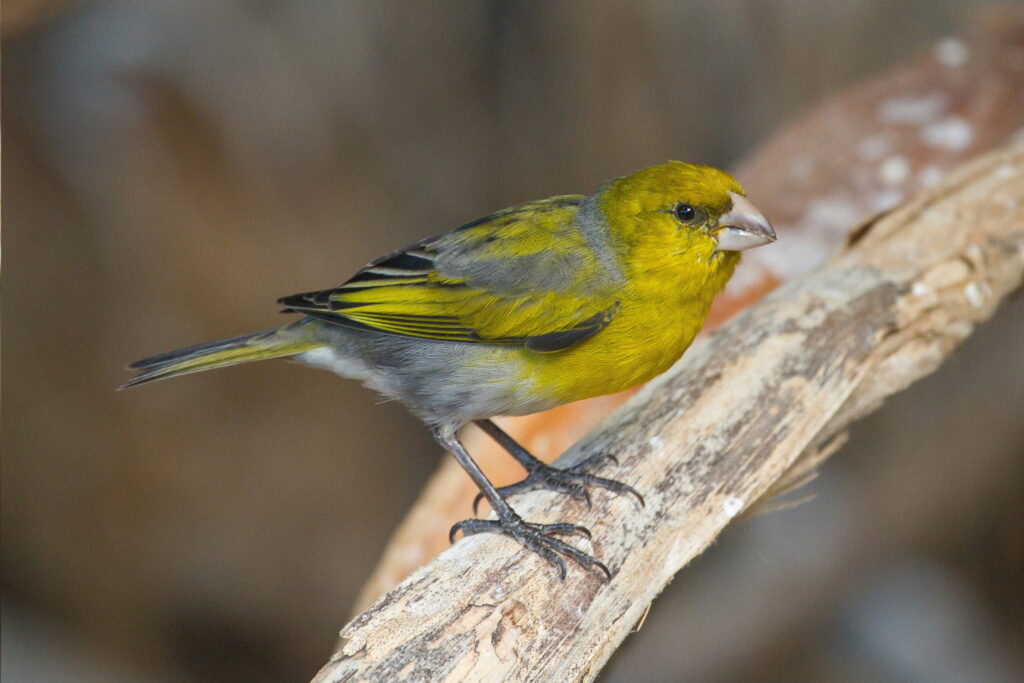
Friendly Finches: Learn About The Palihoa
10 Things We Want To Share About Hawaiʻi’s Charming Palihoa
1. The palihoa, or Nihoa Finch, is a 6-inch-long, ground-nesting member of Hawaiʻi’s famous honeycreeper family (Fringillidae.) Palihoa is a close relative of ʻekupuʻu, or Laysan Finch.
2. Until last month, all the palihoa in the world, about 3000, lived only on Nihoa, an island about 130 miles northwest of Kauaʻi. Nihoa consists of rugged 900-foot tall basalt rock cliffs, is about 1/3 of a square mile in area and has only one tiny beach.
3. In 1967, the U.S. Fish and Wildlife Service added the yellow-and-gray palihoa to the endangered species list because a single severe storm could wipe out the endemic bird’s tiny territory.
4. Fossil records show that palihoa once inhabited Molokai, Maui, and possibly other Hawaiian Islands. Nihoa, being free of predators and disease-carrying mosquitoes, became the birds’ last refuge.
5. In late August, however, thanks to the collaboration of 12 public and private organizations, 49 palihoa were transported and released on Kapou (Lisianski Island) about 129 miles northwest of Kamole (Laysan Island.)
6. Palihoa are easy to catch. Having evolved without predators, when humans visit rugged Nihoa (no small task), the curious finches hop right up to investigate.
7. Palihoa eat anything they find, a bonus to survival. The bird’s stout bill can crush seeds, pluck flowers, pick up bugs, crack eggs, and burrow into fish, bird, and seal carcasses.
8. Because the bird’s original name was lost, the Papahānaumokuākea Native Hawaiian Cultural Working Group gave the name palihoa to the perky finch. Pali refers to Nihoa’s rocky cliffs. Hoa means friend or companion.
9. Hurricane Lala threatened the long-planned translocation project, but workers made it by boat to Nihoa and Kapou, caught and released the birds as planned, and returned home safely.
10. The storm emphasized the importance of establishing additional populations of endangered birds as well as highlighting the difficulties of wildlife work in the remote Northwest Hawaiian Islands.