ʻAlae Kea: What’s The Deal With Those Feet?
10 Things We Want to Share About The ʻAlae Keʻokeʻo aka ʻAlae Kea
1. Coots look like awkward fliers, but over eons these waterbirds have flown from their place of origin in the tropical Americas to continents and islands around the world where they evolved into separate species.
2. Ten coot species exist worldwide: six in South America, one throughout Europe, Asia and Australia, one in Africa, one in North and Central America, and one in Hawaiʻi. An 11th species was last seen on Mauritius in 1693, driven to extinction by hunting and introduced predators.
3. The endangered endemic Hawaiian Coot is found on all the main Hawaiian Islands except Kahoʻolawe. The current population is around 1,500 individuals.
4. ʻAlae keʻokeʻo are waterbirds that dive or dabble at the surface for meals of snails, insects, fish, seeds, leaves, and plant stems. Some individuals forage in mountain streams, golf course ponds, and brackish to saltwater estuaries.
5. Coots may mate for life. Both parents work to build floating nests of grasses, twigs and branches in freshwater ponds, flooded fields, reservoirs, sewage-treatment ponds, and brackish fishponds.
6. Coot species have forehead shields of white, yellow, red, orange, some with dark spots. The shields may protect the bird’s face during foraging and also in territorial disputes.
7. Most ʻalae keʻokeʻo face shields and bills are white, but 3% to 16% of individuals have a dark red shield and some have maroon spots near the bill tip similar to those of American Coot, ʻalae keʻokeʻo’s closest cousin.
8. The ʻalae keʻokeʻo forehead shield is larger and more bulbous than other coot species. The shield extends far enough up the head as to be visible from the rear of the bird.
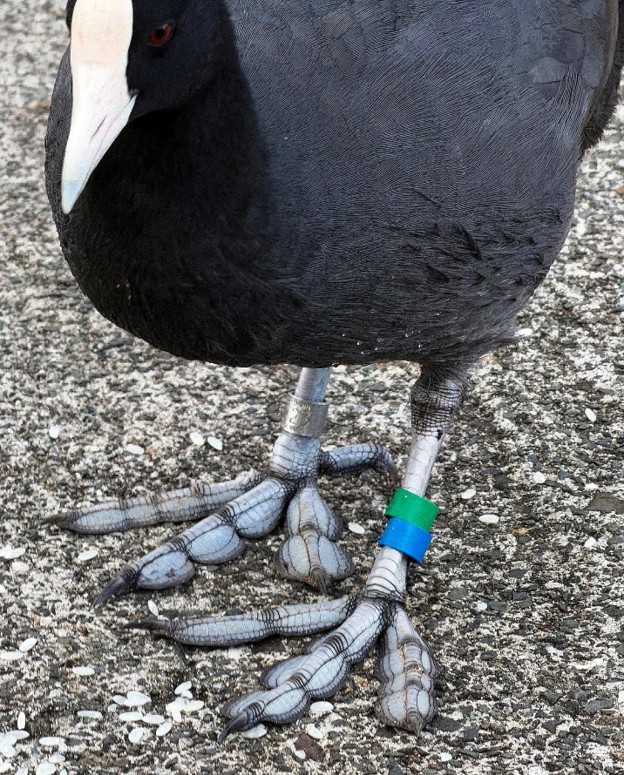
9. And those feet? All coot species have odd-looking lobed feet, good for getting around on both land and water. The lobes flatten when the bird is walking on hard surfaces or stepping on plants or mud. While swimming, the foot’s lobes expand on the backward stroke and collapse on the forward stroke, helping the bird make way.
10. Coots also use their big feet with sharp nails to fight, usually males in territory disputes.
Image above: This leg-banded ʻalae keʻokeʻo was foraging in a parking lot next to Kailua’s Hāmākua Marsh. ©Susan Scott
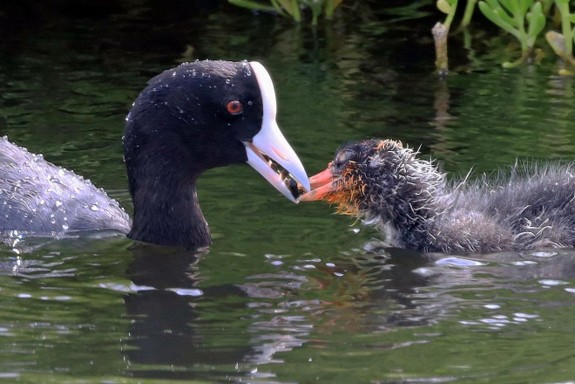
Image below: An ʻalae kea parent feeds its chick ©Tom Fake